 BlackArc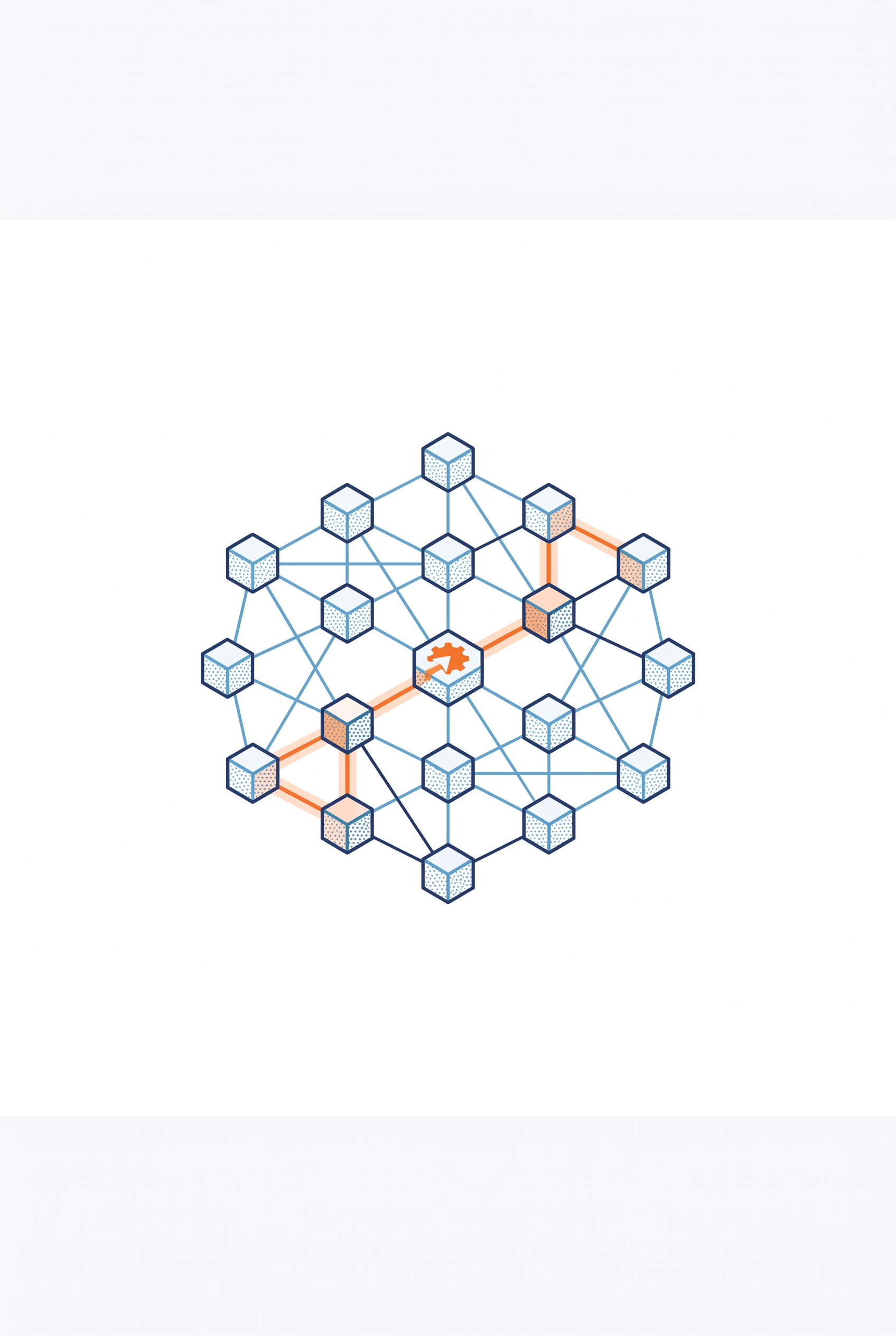
TL;DR
Standard RAG embeds each passage in isolation, so it can’t connect facts that live in different documents — exactly what “multi-hop” questions need. The usual fix (iterative retrieval like IRCoT) works but is slow and expensive because it calls the LLM several times per query. HippoRAG borrows the brain’s trick: build an index of associations once (offline), then traverse it cheaply at query time. Concretely, it (1) uses an LLM to extract a schemaless knowledge graph from every passage, (2) adds “synonym” edges between similar entities using a dense encoder, and (3) at query time extracts the query’s named entities, drops them onto the graph as seeds, and runs Personalized PageRank to let relevance “spread” across multiple hops in one shot. The result: up to ~20 points better recall on hard multi-hop benchmarks than the best single-step RAG, while being 6-13x faster and 10-30x cheaper than iterative retrieval — and it stays comparable to iterative methods in accuracy.
Problem & Motivation
The concrete pain: current RAG can’t integrate knowledge across passage boundaries. Every passage is encoded into its own vector at index time, with no awareness of the others. So if the answer requires chaining “Stanford employs Thomas” + “Thomas researches Alzheimer’s,” and no single passage states both, a vector search for “Stanford professor who works on Alzheimer’s” has nothing close to retrieve. The signal you need is spread across documents that never get embedded together.
The paper sharpens this into two flavors of multi-hop:
- Path-following — the standard benchmark setting, where you can hop document-to-document if you retrieve iteratively.
- Path-finding — the harder case (their headline example) where the two anchor entities (Stanford, Alzheimer’s) never co-occur, so there’s no chain of overlapping passages to follow at all. You need an associative structure that already links them.
Why prior approaches fall short:
- Single-step dense retrieval (Contriever, GTR, ColBERTv2): one vector lookup, no cross-passage reasoning. Cheap but blind to multi-hop.
- Iterative retrieval (IRCoT): retrieve → reason with LLM → retrieve again, repeated. It works on path-following questions but costs N LLM calls per query (slow, expensive) and still fails path-finding.
- Offline-integration methods (RAPTOR, GraphRAG, MemWalker): summarize clusters of documents into new nodes at index time. Better, but the summaries are static — add new data and you have to re-summarize. That breaks the “continually updating memory” goal.
The framing the authors reach for: a real long-term memory should let you add knowledge incrementally (no catastrophic forgetting, no re-summarizing) and integrate it across boundaries cheaply. The human hippocampus does exactly this, and that’s the design they copy.
What’s New (Core Contribution)
- A schemaless, LLM-built KG as a retrieval index (the “hippocampal index”). Before: knowledge graphs for QA were hand-curated or schema-constrained, or graphs were built only from the documents you already retrieved. Now: an instruction-tuned LLM runs open information extraction (OpenIE) over the entire corpus, passage by passage, producing
(subject, relation, object)triples with no fixed schema. The graph is the index. - Single-step multi-hop retrieval via Personalized PageRank (PPR). Before: multi-hop meant iterating retrieval+LLM. Now: extract the query’s named entities, use them as PPR seed nodes, and let one graph-propagation step surface the relevant multi-hop neighborhood. One LLM call (for entity extraction) instead of N.
- Synonymy edges from a dense encoder (“parahippocampal regions”). Before: graph nodes only connect if a triple literally links them. Now: any two entity nodes whose embeddings are cosine-similar above threshold τ get an extra edge, so “JFK” and “John F. Kennedy” become traversable. This is what makes the noisy LLM-extracted graph robust enough to walk.
- Node specificity — a local, IDF-like importance signal. Before: IDF needs a global count over the whole corpus. Now: weight each seed node by
1/(# passages it appears in)— information already stored at the node — so rare, discriminative entities get more PPR mass. Cheap, local, and it measurably helps.
The genuine novelty is the combination: LLM-as-graph-builder + dense-encoder-as-synonym-bridge + PPR-as-single-step-reasoner, mapped one-to-one onto a memory theory. PPR and OpenIE are old; using them this way for incremental, single-step multi-hop RAG is the contribution.
How It Works (Technically)
There are two phases. Offline indexing (done once, updated incrementally) builds the graph. Online retrieval (per query) walks it.
The three components (and their brain analogy)
| Brain part | HippoRAG part | Job |
|---|---|---|
| Neocortex | An instruction-tuned LLM | Turn raw text into discrete concepts (triples / named entities) |
| Hippocampus | KG + Personalized PageRank | Store associations; do pattern completion (spread activation) |
| Parahippocampal regions | Dense retrieval encoder | Bridge near-identical concepts with synonym edges |
Offline indexing, step by step
- OpenIE per passage. For each passage, prompt the LLM (1-shot) to first extract named entities, then feed those back in to extract triples
(subject, relation, object). Triples include noun-phrase concepts beyond just named entities. The two-step prompt balances generality vs. an entity bias. The subjects/objects become nodesN; the relations become edgesE. - Synonym edges. Encode every node with the retrieval encoder
M. For any pair whose cosine similarity exceeds τ (= 0.8 in the paper), add a synonymy edge toE'. These extra edges let the walk cross paraphrase gaps. - The passage-membership matrix
P. Build a|N| × |P|matrix whereP[i][j]= how many times node i was extracted from passage j. This is the bridge from “graph nodes” back to “which passages to return.” Adding a new document = OpenIE it, add its nodes/edges, append a column toP. No re-summarization.
Online retrieval, step by step
Take the query q = “Which Stanford professor works on the neuroscience of Alzheimer’s?”
-
Extract query named entities
Cq = {c1...cn}via a 1-shot LLM prompt → here{Stanford, Alzheimer's}. (This is the only LLM call at query time.) -
Link entities to graph nodes. Encode each
ciwithM, and pick the most-similar existing node:ri = e_k where k = argmax_j cosine_similarity(M(ci), M(ej))In plain English: “for each entity the user mentioned, find the single closest concept already living in the graph.” These chosen nodes
Rqare the seeds. -
Build the personalized seed distribution
n⃗. Put probability only on the seed nodes, zero everywhere else. Then scale each seed by its node specificitys_i = 1 / |P_i|(whereP_i= passages node i came from). Rare entities (Stanford appears in fewer docs than “professor”) get a bigger spike. In plain English: start the random walk only from what the question is about, and trust rare, specific anchors more than common ones. -
Run Personalized PageRank. PageRank imagines a random surfer hopping along edges; Personalized PageRank adds a “teleport” that, on restart, always jumps back to the seed set (controlled by the damping factor, 0.5 here). Run to convergence and you get a new distribution
n⃗'over all nodes — high mass on nodes that are jointly reachable from the seeds. “Professor Thomas,” reachable from both Stanford and Alzheimer’s, lights up even though no single passage connected them. This is the multi-hop reasoning, executed as one matrix computation. -
Score passages. Multiply the node distribution by the membership matrix:
p⃗ = Pᵀ · n⃗'. Each passage’s score = sum of the PPR mass of the nodes it contains. Rank passages byp⃗, return top-k.
The whole “reasoning” is: pick seeds → spread probability → read off which passages the high-probability nodes belong to. No iterative LLM loop.
Architecture & data flow
flowchart LR
  subgraph Offline["Offline Indexing (once, incremental)"]
    P1[Passages] --> LLM1[LLM OpenIE]
    LLM1 --> KG[(Schemaless KG: nodes + relation edges)]
    P1 --> ENC1[Dense encoder]
    ENC1 -->|cosine > tau| SYN[Synonym edges]
    SYN --> KG
    LLM1 --> MAT[node-to-passage matrix P]
  end
  subgraph Online["Online Retrieval (per query)"]
    Q[Query] --> NER[LLM extracts query entities]
    NER --> LINK[Link to nearest KG nodes = seeds]
    LINK --> SPEC[Weight seeds by node specificity 1/passages]
    SPEC --> PPR[Personalized PageRank over KG]
    PPR --> SCORE[Multiply by matrix P -> passage scores]
    SCORE --> TOPK[Top-k passages]
  end
  KG -.used by.-> PPR
  MAT -.used by.-> SCORE
Schematic Personalized PageRank on a tiny KG. The two seed nodes (Stanford, Alzheimer's) get injected probability; watch the mass flow along edges and pool on the node jointly reachable from both (Thomas). Click a node to make it a seed. This illustrates *why* a single propagation step does multi-hop work.
The algorithm, simplified
# Offline: build the hippocampal index once. Incremental — call again per new doc batch.
def index(passages, llm, encode, tau=0.8):
    nodes, edges, P = set(), set(), {}          # P[(node, passage_id)] = count
    for j, passage in enumerate(passages):
        ents = llm.extract_entities(passage)     # 1-shot OpenIE, step 1
        triples = llm.extract_triples(passage, ents)  # (subj, rel, obj), step 2
        for s, r, o in triples:
            nodes |= {s, o}; edges.add((s, o))   # relation edge
            P[(s, j)] = P.get((s, j), 0) + 1
            P[(o, j)] = P.get((o, j), 0) + 1
    # synonym edges bridge paraphrases ("JFK" ~ "John F. Kennedy")
    vecs = {n: encode(n) for n in nodes}
    for a in nodes:
        for b in nodes:
            if a < b and cosine(vecs[a], vecs[b]) > tau:
                edges.add((a, b))                # E'
    return Graph(nodes, edges), P, vecs

# Online: answer a query with ONE llm call (entity extraction) + one PPR run.
def retrieve(query, graph, P, vecs, llm, encode, k=5):
    q_ents = llm.extract_entities(query)         # only LLM call at query time
    seeds = {}
    for c in q_ents:
        node = nearest_node(encode(c), vecs)     # link entity -> graph node
        specificity = 1.0 / num_passages(node, P)  # local IDF-like weight
        seeds[node] = specificity                # seed mass, weighted
    node_scores = personalized_pagerank(graph, seeds, damping=0.5)  # multi-hop in 1 step
    passage_scores = {}                          # p = P^T . node_scores
    for (node, j), count in P.items():
        passage_scores[j] = passage_scores.get(j, 0) + count * node_scores.get(node, 0)
    return top_k(passage_scores, k)
Built on Prior Work
| Prior idea | What it gave | What this paper changes |
|---|---|---|
| OpenIE (Angeli/Banko et al.) | Schemaless (s,r,o) extraction from text | Uses an LLM to do it over the whole corpus and treats the output graph as the retrieval index, not an end product |
| Personalized PageRank (Haveliwala) | Bias graph propagation toward seed nodes | Repurposes it as the multi-hop reasoner — seeds = query entities, output = passage relevance |
| Dense retrieval encoders (Contriever, ColBERTv2) | Semantic similarity for retrieval | Demoted to a synonym-edge builder + entity linker, not the primary retriever |
| Hippocampal indexing theory (Teyler & Discenna) | Cognitive model of human long-term memory | Maps each neural component onto an engineered part (LLM=neocortex, KG+PPR=hippocampus, encoder=PHR) |
| IRCoT (Trivedi et al.) | Iterative retrieve-and-reason for multi-hop | Replaces the loop with one PPR step; also shows the two combine for further gains |
| RAPTOR / GraphRAG | Offline cross-document integration via summaries | Integrates via graph edges instead, so new data is added incrementally with no re-summarization |
| Node specificity (this paper) | — | A local, neurobiologically-plausible IDF substitute computed from node-passage counts |
Results & Evidence
Setup. Three multi-hop QA benchmarks: MuSiQue and 2WikiMultiHopQA (the genuinely hard ones) plus HotpotQA (known to be a weak multi-hop test). 1,000 questions each, with supporting + distractor passages pooled into a retrieval corpus. Backbone: GPT-3.5-turbo-1106 for extraction; Contriever or ColBERTv2 as encoder. Metrics: Recall@2/@5 for retrieval, EM/F1 for QA. Two tuned hyperparameters (τ=0.8, damping=0.5) on 100 MuSiQue training examples; authors note robustness to them.
Headline numbers (single-step retrieval, R@2 / R@5):
- 2WikiMultiHopQA: ColBERTv2 baseline 59.2 / 68.2 → HippoRAG 70.7 / 89.1 (+11 / +21 points — the big win).
- MuSiQue: 37.9 / 49.2 → 40.9 / 51.9 (+3 / +3 — modest).
- HotpotQA: roughly comparable, slightly behind the strongest baselines (it needs little real integration).
Efficiency: online retrieval is 6-13x faster and 10-30x cheaper than IRCoT, because IRCoT pays for multiple LLM generations per query while HippoRAG pays for one entity-extraction call.
Complementarity: feeding HippoRAG as IRCoT’s retriever stacks gains — e.g., 2Wiki R@5 jumps to ~93.9. So it’s not strictly either/or.
QA tracks retrieval, as expected (it only changes what gets retrieved).
What the evidence does NOT establish — read this before shipping it:
- Scale is unproven. Corpora are ~10-22k passages. The authors explicitly flag that they have not validated efficiency/efficacy as the graph grows to production scale. PPR over millions of nodes is a real engineering question.
- The 20% is the best-case dataset. 2Wiki is “entity-centric” — tailor-made for an entity graph. MuSiQue gains are ~3 points; HotpotQA shows none. The improvement is highly task-dependent.
- Path-finding is a case study, not a benchmark. The most exciting claim (solving questions iterative methods can’t) is illustrated qualitatively, not measured at scale.
- Quality bottleneck is the LLM extraction. Their own error analysis says most failures come from NER/OpenIE mistakes, and OpenIE gets less consistent on longer documents. Garbage triples → garbage graph.
- Off-the-shelf everything. No component is fine-tuned, which is honest but means the numbers are a floor, not a ceiling — and also that someone else could move them.
How You’d Use It
This is a concrete upgrade path for the retrieval layer of any RAG system you run, and a differentiator on a specific class of problem.
- Your applications — “connect-the-dots” search. Siloed knowledge — legal case files, scientific literature, internal wikis, due-diligence document rooms — repeatedly produces questions whose answer is split across documents. Vanilla RAG fails these and users feel it (“it can’t find things it obviously knows”). HippoRAG is a clean answer: build the association graph once, answer cross-document questions in one shot.
- Your business — a cost lever vs. agentic retrieval. If you’re currently doing multi-step / ReAct-style retrieval loops to handle multi-hop, you’re paying per-query for several LLM calls and latency. Swapping the inner retriever to HippoRAG (or using it as the retriever inside the loop) cuts both — a direct margin story at volume.
- Your harness — the long-term memory store for a multi-agent system. A research-agent swarm can write extracted triples into a shared knowledge graph as it reads, and any agent can query it with PPR. Because indexing is incremental (add edges, no re-summarize), it fits an always-on memory that grows during a session — unlike RAPTOR/GraphRAG, which need re-summarization when memory changes.
- Your business — the moat is the graph, not the model. The valuable artifact is your own accumulated association graph over the corpus you actually work with. That’s sticky, hard to replicate, and improves over time — a better position than “we wrap an LLM.”
Realistic effort: a working v1 over a single corpus is days, not months (see below). The hard parts are extraction quality and scaling the graph, which is where the real engineering effort goes.
Build Your Own (Minimal Recipe)
Smallest version that captures ~80% of the value:
Components
- OpenIE extractor — any capable LLM with the two-step prompt (entities → triples). Start with GPT-4o-mini or Llama-3.1 for cost; the paper shows open models reach similar quality.
- Graph store —
networkxis plenty for a prototype; it hasnx.pagerank(personalization=...)built in. Move to a real graph DB only when you outgrow memory. - Dense encoder —
sentence-transformers(e.g.all-MiniLMor Contriever) for synonym edges and entity linking. - Membership matrix — a
scipy.sparsematrix or even a dict mapping(node, passage_id) → count.
Build order
- Pipe passages through OpenIE; persist triples. Verify extraction quality on 20 passages by hand before anything else — this is your ceiling.
- Build the graph (relation edges), encode nodes, add synonym edges above τ≈0.8.
- Build the node→passage matrix.
- Implement query path: entity extraction → nearest-node linking → specificity-weighted seeds →
nx.pagerank(G, personalization=seeds)→Pᵀ · scores→ top-k. - Evaluate Recall@k on ~100 held-out multi-hop questions before tuning τ and damping.
The 1-2 genuinely hard parts
- Extraction quality / canonicalization. Inconsistent entity surface forms (“Dr. Thomas” vs “Thomas A.”) fragment the graph. Synonym edges help but don’t fully fix it; a light entity-resolution pass pays off.
- Scaling PPR.
networkxPPR is fine to ~10⁵ nodes. Beyond that you need sparse linear-algebra PPR (power iteration on a CSR matrix) or an approximate/local PPR (push-based) to keep query latency low. This is the main thing that breaks in production.
How to Improve It
- Fine-tune the extractor. The authors’ own error analysis blames NER/OpenIE for most failures. A small fine-tuned extraction model (or a verification pass that re-checks triples) would lift accuracy and reduce the synonym-edge crutch — the highest-leverage fix.
- Relation-aware traversal. Plain PPR ignores edge semantics — it treats “researches” and “employs” identically. Letting the query bias the walk toward relevant relation types (typed/weighted edges, or a learned edge prior) should improve precision, especially on MuSiQue-style chains.
- Hybrid scoring with dense retrieval. PPR can over-reward well-connected hub nodes and miss passages whose relevance is semantic but not entity-mediated. Blend
p⃗with a normal dense-retrieval score (reciprocal-rank fusion) to cover both regimes — likely closes the HotpotQA gap. - Entity resolution / canonical nodes. Replace pure cosine-similarity synonym edges with proper coreference + entity linking so duplicate entities collapse into one node. Cleaner graph, sharper specificity weights.
- Scale validation + approximate PPR. Stand up a million-passage corpus and measure latency/recall with push-based local PPR. This is the open empirical question the paper names; answering it is both a research contribution and a productization requirement.
- Adaptive seeds. Currently seeds come only from query named entities. Add a fallback that also seeds from top dense-retrieval hits when entity extraction is sparse (short or entity-light queries), so the method degrades gracefully.
Glossary
- RAG (Retrieval-Augmented Generation) — give an LLM relevant retrieved text at query time so it answers from current/external knowledge instead of only its weights.
- Multi-hop question — a question whose answer requires chaining facts from more than one passage.
- Path-following vs. path-finding — path-following: the chain of supporting passages overlaps so you can hop between them; path-finding: the anchor entities never co-occur, so there’s no chain to follow — you need an association structure.
- OpenIE (Open Information Extraction) — extracting
(subject, relation, object)triples from free text with no predefined schema. - Schemaless knowledge graph — a graph of entities/relations where edge and node types aren’t fixed in advance; whatever the LLM extracts is allowed.
- PageRank — ranks graph nodes by a random surfer’s long-run visit probability; well-connected nodes score higher.
- Personalized PageRank (PPR) — PageRank where restarts always teleport back to a chosen seed set, biasing scores toward nodes near those seeds.
- Damping factor — probability the surfer keeps walking vs. teleports back to seeds (0.5 here); controls how far activation spreads.
- Seed nodes — the graph nodes PPR starts and restarts from; here, the query’s linked entities.
- Node specificity — a local IDF-like weight,
1/(# passages a node appears in); rarer entities count more. - Synonymy edge — an extra edge added between two nodes whose embeddings are similar above threshold τ, bridging paraphrases.
- Dense / retrieval encoder — a model that maps text to a vector so similarity = cosine distance (e.g. Contriever, ColBERTv2).
- IRCoT — an iterative retrieve-then-reason-with-chain-of-thought method; strong on multi-hop but multiple LLM calls per query.
- Recall@k — fraction of needed supporting passages found in the top-k retrieved.
- EM / F1 — Exact Match and token-overlap F1 between predicted and gold answers.
- Hippocampal indexing theory — cognitive theory that human long-term memory stores a sparse index of associations (hippocampus) pointing to richer representations (neocortex), enabling recall from partial cues.
- Pattern separation / completion — making distinct experiences distinguishable (separation) vs. reconstructing a whole memory from a partial cue (completion).