 BlackArc
TL;DR
Companies use teams for three reasons: teams do better work, they combine different expertise, and people like working with people. This paper asks whether a chat model can deliver some of each. P&G ran a one-day product-innovation workshop on real business-unit problems and randomly put people in one of four cells: alone or in an R&D + Commercial pair, with or without a GPT-4 tool. Blind expert raters scored 550 solutions. A pair without AI beat a lone worker by 0.24 standard deviations; a lone worker with AI beat the lone worker by 0.37 SD, which is statistically the same as the pair, in about 16% less time. Pairs with AI scored about the same on average as individuals with AI (0.39 SD), but were roughly three times as likely as the baseline to land in the top 10%. AI users also wrote ideas that mixed technical and commercial angles no matter which function they came from, and they reported more positive and fewer negative emotions.
Problem & Motivation
Most evidence on generative AI at work measures one person doing one task: call-centre agents, consultants writing memos, programmers writing code. Real value in big organizations is mostly produced by small cross-functional teams, and those teams are expensive. You have to find calendar time for an R&D person and a Commercial person at once, and the two cultures do not always mesh. P&G leadership said exactly this: early-stage “seed” ideas matter most for the whole innovation funnel, and coordination friction lowers their quality.
So the open question is not “does AI make a person faster?” It is “can AI stand in for the reasons we put people in teams?” Prior lab work (Dell’Acqua et al. 2023a) had found that even when an AI beat humans at a task, human + AI teams sometimes did worse because of trust and coordination failures. Older socio-technical research (Trist and Bamforth, 1951 onward) says new technology often strips the social side out of work and makes people less happy. Nobody had a large, randomized, in-firm test of how a chat model interacts with real team structure.
What’s New (Core Contribution)
- A 2x2 field experiment on team structure, not just AI use. Before: AI studies compared “with AI” vs “without AI” for individuals. Now: team vs individual is crossed with AI vs no AI, with real employees on their own business unit’s problems. That crossing is what lets you ask “does AI substitute for a teammate, or complement one?”
- Measures all three reasons teams exist. Performance (blind expert quality score, time, length), expertise (core vs non-core product-development roles; how technical vs commercial the idea is), and sociality (pre/post change in positive and negative emotions). Most AI studies measure only the first.
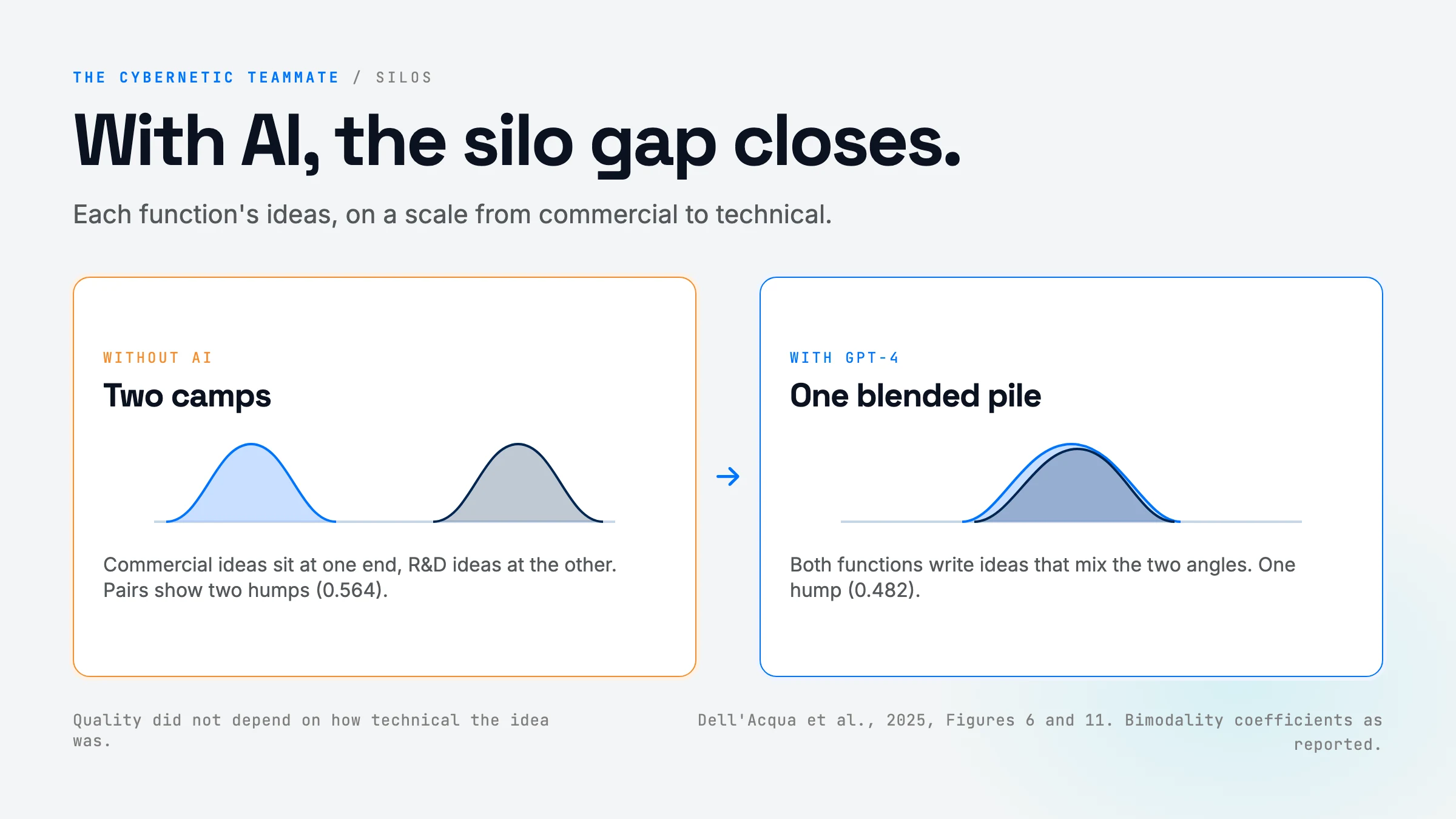
- The “silo-breaking” finding. Without AI, R&D people write technical ideas and Commercial people write commercial ideas. With AI, the two distributions overlap. This is a new, measurable claim about AI as a boundary-spanner.
- Substitution on average, complementarity at the tail. AI-alone matches team-no-AI on mean quality, but only team-plus-AI moves the top-decile rate significantly. This split is the most useful practical result for anyone deciding how to staff work.
What is not new: the GPT-4 tool itself is a plain chat interface with a library of well-known prompting patterns (persona, chain-of-thought, few-shot, constraints). The productivity and time-savings results repeat earlier individual-level studies. The novelty is the design and the team-level outcomes.
How It Works (Technically)
This is an empirical paper, so “the mechanism” is the experiment plus the statistics that turn ratings into effect sizes. Here is the whole pipeline.
Step 1: Recruit and stratify. 811 Commercial and R&D professionals from four business units (Baby Care, Feminine Care, Grooming, Oral Care) across Europe and the Americas joined a one-day virtual workshop as part of an AI-upskilling program. 776 were randomized. Randomization was stratified by business unit x geography (8 clusters), which means each cluster was split across the four conditions separately. That stops one condition from accidentally getting all the Oral Care people.
Step 2: Assign one of four cells.
| No AI | With AI (GPT-4 via Azure) | |
|---|---|---|
| Individual | Control (154 people) | T2: Individual + AI (155) |
| Team of 2 (1 R&D + 1 Commercial) | T1: Team, no AI (115 teams) | T3: Team + AI (126 teams) |
AI conditions got one hour of prompt training plus a PDF of ready-made prompts. Teams met over Microsoft Teams; one person, chosen at random, shared their screen and submitted.
Step 3: Do the task. Each unit got a real problem statement from its business unit (for example, “how do we get consumers who have never tried product form X to add it to their regimen?”) plus market data. The output was a structured proposal: idea name, recommended solution, rationale, critical work required, and resources needed.
Step 4: Score blind. 22 evaluators (MBA and engineering students or recent graduates) did 1,595 ratings on 550 solutions, about 2.9 per solution. Each rating gave 1-10 scores for overall quality, novelty, impact, business potential, and feasibility, plus a 1-7 “technical vs commercial” score. Raters did not know the condition.
Step 5: Standardize against the control group. The raw quality score is converted to a z-score using the control group’s mean and standard deviation:
z = (score - mean_control) / sd_control
Plain English: “how many control-group standard deviations above an average lone worker is this solution?” A result of +0.37 means the average AI-alone solution sits about where the 64th percentile lone worker sits. This puts every outcome (quality, emotions) on one comparable ruler.
Step 6: Regress. The main model, per solution i:
Y_i = b0 + b1*TeamNoAI_i + b2*AloneAI_i + b3*TeamAI_i + g*Controls_i + d*FE_i + e_i
What this computes: three dummy variables switch on for the three treatment cells, so b1, b2, b3 are simply “the average difference between this cell and the lone-no-AI control.” Because assignment was random, those differences are causal. The fixed effects (FE: day and business unit) soak up “Grooming problems were just easier” or “the July session was different.” The controls (band level, tenure, gender, prior ChatGPT use) only tighten the estimates. They should not change the story, and they do not. Robust standard errors handle the fact that some cells are noisier than others. The key comparisons are then between coefficients: is b2 different from b1 (does AI replace a teammate)? Is b3 different from b2 (does the human teammate still add anything once AI is there)?
Step 7: Extra lenses. Top-10% indicator (a linear probability model on “is this solution in the top decile?”); self-rated “will I be top 10%?”; the bimodality coefficient of the technicality distribution; sentence-level AI retention (share of submitted sentences that are at least 90% similar to an AI output); and embedding similarity between solutions.
Architecture & data flow
flowchart LR
  P[776 P&G professionals<br/>R&D + Commercial] --> S[Stratified randomization<br/>4 BUs x 2 regions]
  S --> C0[Alone, no AI]
  S --> C1[Team, no AI]
  S --> C2[Alone + GPT-4]
  S --> C3[Team + GPT-4]
  C0 --> SOL[550 structured solutions]
  C1 --> SOL
  C2 --> SOL
  C3 --> SOL
  SOL --> R[22 blind raters<br/>1,595 ratings]
  R --> Z[Standardize vs control]
  Z --> OLS[OLS with FE + controls]
  SVY[Pre/post emotion survey] --> OLS
  LOG[Prompt logs + transcripts] --> RET[Retention and similarity]
What happens inside one AI-enabled session
sequenceDiagram
  participant H as Professional (or pair)
  participant AI as GPT-4 tool
  H->>AI: paste problem statement + "Basic Research" prompt
  AI-->>H: introduces itself, asks for documents
  AI-->>H: asks 2-3 scoping questions, one at a time
  H->>AI: answers (domain knowledge enters here)
  H->>AI: "Alternative Structuring" prompt
  AI-->>H: 3-4 framings, analysis only, no solution
  H->>AI: "General Ideation" prompt
  AI-->>H: 20 ideas -> make bolder and distinct -> 40-80 word concepts
  H->>AI: "Simulated Customer Interview"
  AI-->>H: plays consumer personas, waits for questions
  H->>H: select, edit, write the 5-part proposal
Effect sizes from the paper's Table 2 (quality), Table 6 (positive emotions), Table 7 (negative emotions) and Table 10 (top-10% rate). Click the tabs to switch outcome. Bars are coefficients versus the lone-no-AI control; whiskers are about 95% intervals (coefficient plus or minus 1.96 standard errors). Built from the paper's reported numbers.
The algorithm, simplified
The part worth stealing is not the regression. It is the prompt protocol that made GPT-4 act like a teammate instead of an answer machine. The paper’s Appendix C names the tricks: purposeful elicitation (the AI must ask, then stop and wait), constraints (“do not provide a solution”), personas, role-play, and step-by-step diverge-then-converge ideation. Here is that protocol as a loop you could put in your own tool.
# llm(messages) -> str ; ask_human(text) -> str  (stubs)
PHASES = [
    # (persona, instruction, must_wait_for_human)
    ("research assistant", "Ask 2-3 scoping questions about the problem, ONE at a time.", True),
    ("innovation specialist", "Offer 3-4 reframings of the problem. Analyze only. Do NOT propose a solution.", True),
    ("ideation partner", "List 20 short ideas. Then rewrite them so each is bolder and no two overlap. "
                         "Then expand each into a 40-80 word concept.", False),
    ("consumer psychologist + simulated customer",
     "Play a customer persona the human picks. Answer only what you are asked. Wait for each question.", True),
]

def cybernetic_teammate(problem, context_docs):
    history = [{"role": "system", "content": f"Problem: {problem}\nContext: {context_docs}"}]
    for persona, instruction, must_wait in PHASES:
        history.append({"role": "system", "content": f"You are a {persona}. {instruction}"})
        while True:
            reply = llm(history)
            history.append({"role": "assistant", "content": reply})
            human = ask_human(reply)            # pause point: the human's domain knowledge enters here
            history.append({"role": "user", "content": human})
            if not must_wait or human.strip().lower() == "next":
                break                           # the human, not the model, decides when a phase ends
    # the human writes the final proposal; the model drafted, the person selected and edited
    return ask_human("Write the 5-part proposal: name, solution, rationale, critical work, resources.")
Why this is the core idea: every phase with must_wait=True forces a turn where the person must contribute. That is how a lone R&D engineer ends up writing commercially aware ideas. The model asks the commercial questions a Commercial teammate would have asked, and the engineer has to answer them.
Built on Prior Work
| Prior idea | What it gave | What this paper changes |
|---|---|---|
| Team-performance research (Wuchty et al. 2007; Deming 2017; Jones 2009 “burden of knowledge”) | Teams win because problems need more knowledge than one head holds | Tests whether a model can supply that missing knowledge to one head |
| Knowledge-based view (Kogut and Zander 1992; Nickerson and Zenger 2004) | Value comes from recombining specialized knowledge across functions | Measures recombination directly as the technical vs commercial mix of the output |
| Individual GenAI field studies (Noy and Zhang 2023; Dell’Acqua et al. 2023b “jagged frontier”; Brynjolfsson et al. 2025; Peng et al. 2023) | AI raises individual speed and quality, most for less experienced workers | Moves the unit of analysis from the individual to the team; crosses AI with team structure |
| Human-AI coordination lab work (Dell’Acqua et al. 2023a) | Human + AI teams can underperform due to trust and coordination failures | In a real firm with a chat interface, teams with AI did not underperform; they did best at the tail |
| Socio-technical systems (Trist and Bamforth 1951) and conversational-agent well-being work (Li et al. 2023, 2024) | Tech often erodes the social side of work; chatbots can improve mood | Measures emotions pre/post in a work task; finds AI-alone matches or beats team-no-AI on positive affect |
| Cybernetics (Wiener 1948) | Systems that adjust via feedback loops can take part in a process | Supplies the “cybernetic teammate” label: AI as a feedback partner, not a static tool |
Results & Evidence
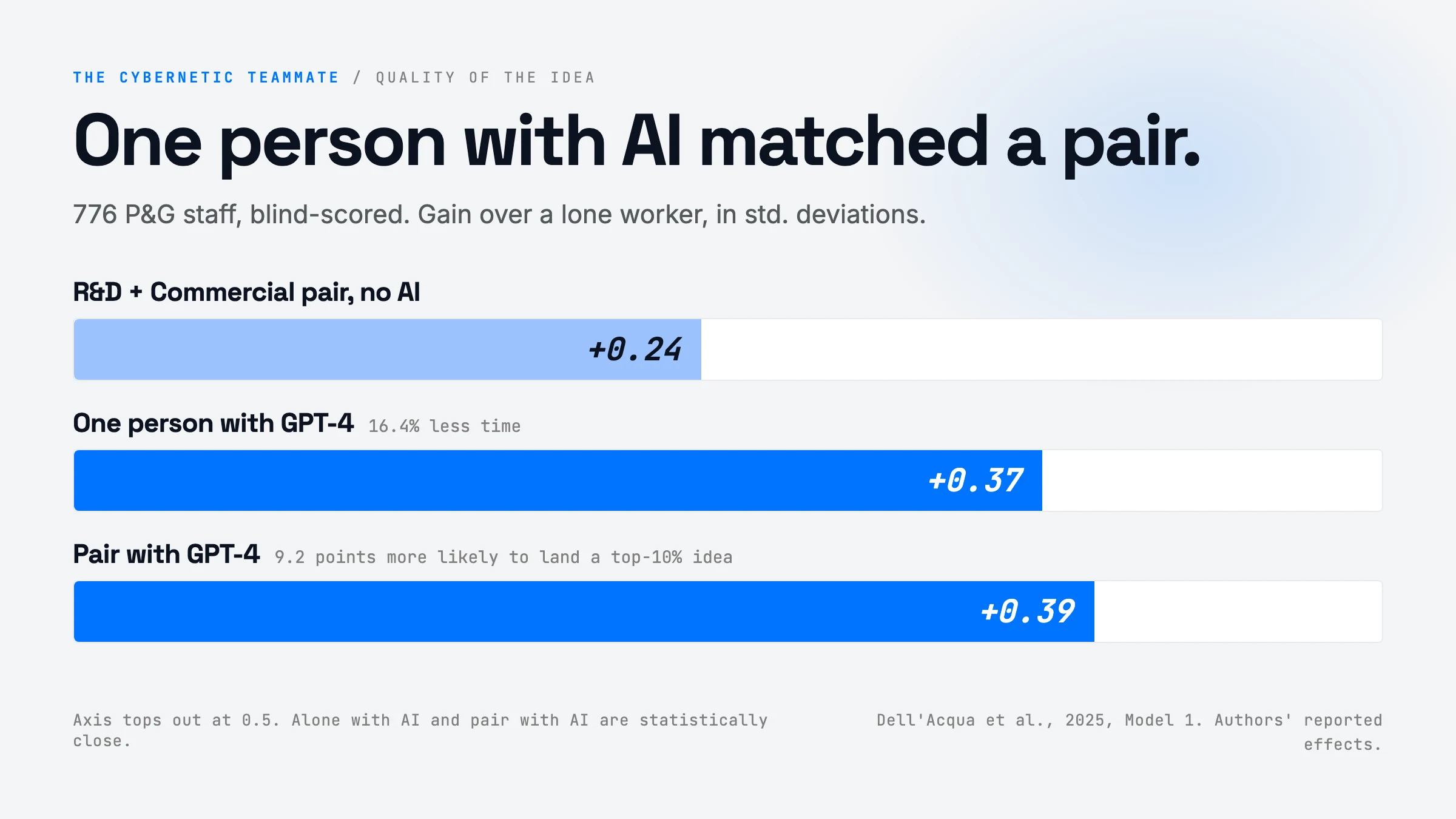
Headline numbers (Model 1, standardized vs lone-no-AI control):
| Outcome | Team, no AI | Alone + AI | Team + AI |
|---|---|---|---|
| Quality (SD) | +0.24** | +0.37*** | +0.39*** |
| Time spent (log points) | +0.04 (n.s.) | -0.37*** (paper reports 16.4% less time) | -0.32*** (paper reports 12.7% less) |
| Solution length (words; control ~380) | +30 (n.s.) | +505*** | +544*** |
| Top-10% probability (control 5.8%) | +3.7 pp (n.s.) | +1.9 pp (n.s.) | +9.2 pp** |
| Positive emotions (SD) | +0.27** | +0.46*** | +0.64*** |
| Negative emotions (SD) | -0.14 (n.s.) | -0.23** | -0.24** |
(** p<0.05, *** p<0.01; n.s. = not significant. Note: a -0.37 log-point gap would usually translate to about 30% less time, not 16%. The paper’s text and Table 4 do not reconcile this, so treat the exact time saving with care. The direction is clear.)
Expertise. Split by whether product development is the person’s core job: non-core employees in a team without AI gained almost nothing (+0.02 SD, n.s.). Non-core employees alone with AI gained +0.32 SD, close to core-job teams without AI (+0.31). On idea orientation, without AI, Commercial people’s ideas clustered at the commercial end and R&D’s at the technical end; with AI, the two distributions overlapped. Teams without AI showed a bimodal mix of ideas (bimodality coefficient 0.564; above about 0.555 suggests two humps, which reads as “one teammate dominated”). Teams with AI were unimodal (0.482). Quality did not depend on technicality, so the balancing did not cost quality.
Confidence gap. AI users were 9.2 pp less likely to expect a top-10% result, even though their solutions scored higher. People underrate AI-assisted work, or distrust their claim to it.
How AI was used. Sentence-level retention of AI text was strongly skewed high; many submissions were more than 75% AI-authored sentences. Those at 100% retention averaged 23.9 prompts, so this was iterated, not pasted. A second group retained 0%, using AI only to brainstorm. AI-aided solutions were more semantically similar to each other than human-only ones (the known homogenizing effect), but much less similar than raw one-shot GPT-4o answers. Humans were steering.
Schematic of the silo finding (Figures 6 and 11). Toggle AI on and off. Without AI, Commercial (green) and R&D (amber) ideas sit at opposite ends of the technical-commercial axis, and pair output is two-humped. With AI they overlap into one hump. Curve shapes are illustrative; the bimodality coefficients (0.564 vs 0.482) are the paper's.
What the evidence does NOT establish:
- One day, one task type, one firm. A virtual one-day workshop is not months of real teamwork with rework, politics, and handoffs. The authors say so.
- Pairs only, always cross-functional. Larger teams, or same-function pairs, may behave differently. “AI replaces a teammate” here means “replaces the second person in a two-person R&D + Commercial pair.”
- The rating is a weak instrument. Inter-rater reliability is modest (ICC2 0.45, Pearson r 0.20 between raters). Raters were students and recent graduates, not P&G executives, and nobody knows which ideas would have worked in market. Effects of 0.1-0.2 SD between cells are inside the noise.
- Length confound. AI solutions were about 2.3x longer. Raters who see longer, more thorough-looking proposals may score them higher. The paper does not control for length in the quality regression. Some of the “quality” gain may be “looks more complete.”
- “Team + AI is best at the tail” is thin. Top-10% is about 55 solutions. Team + AI vs Team-no-AI is p = 0.19 and vs Alone + AI is p = 0.06. It is suggestive, not settled.
- Emotions are self-reports from people in an AI upskilling program who opted in. Novelty and enthusiasm for the tool can inflate them. The paper’s own link to “expected future AI use” is correlation.
- Training is confounded with AI. Only AI cells got the one-hour prompt training before the task. You cannot fully separate “AI” from “an hour of structured method coaching plus a prompt library.”
- 2024 model, plain chat UI. GPT-4 / GPT-4o in a chat window. Both a ceiling (current models are stronger) and a floor (no shared workspace, no agent features) apply.
How You’d Use It
Your workflows and methodologies. The most direct lesson: when you work alone with a model on an open-ended problem, use it the way the P&G prompts did. Have it ask you questions before it answers. Have it reframe the problem without solving it. Then have it diverge to 20 options and converge. Make it role-play the stakeholder you lack (the commercial person, the customer, the ops lead). Cost: a handful of saved prompts. What must be true: the task is ideation or early-stage design where breadth matters. On tasks with a single right answer, the elicitation turns are just overhead.
Your applications. If you build a product where users do judgment-heavy work (planning, proposals, design briefs), build a “missing teammate” mode, not an answer box. Slot it in as a phased assistant with forced pause points, like the pseudocode above. It improves breadth and lets non-specialists produce balanced output. It costs you UX work on turn-taking and some user patience. To pay off, users must value the result over speed. Add a step that shows users how strong their draft is (for example, a rubric score). The confidence-gap finding says people will otherwise underrate AI-assisted work and may not ship it.
Your business. The staffing question is the real one. For routine “decent idea fast” work, one person with a good AI setup gets you team-level average quality, in less time, with no calendar coordination. For “we need a breakthrough,” keep the cross-functional pair and give them AI; that is the only cell that moved the top-decile rate. Decide which of those two games each process is playing before you cut or add headcount. P&G itself cared about the tail (footnote 16).
Your harness. If you run multi-agent systems, the paper is evidence for persona agents that represent a missing function. A “commercial reviewer” agent attached to a technical agent’s output is the machine version of the silo-breaking effect. Watch the homogenization finding: many users with the same model and prompts converged on similar ideas. If you generate many candidates, inject diversity on purpose (different personas, random constraints, the paper’s “must be usable by an astronaut” trick), and measure embedding spread so you know if your candidates are collapsing.
Build Your Own (Minimal Recipe)
Two things are worth building: the teammate tool, and a mini version of the experiment so you know whether it helps your work.
A. The teammate tool (an afternoon).
- A phase list like
PHASESabove, stored as plain prompt templates. Start from the paper’s Appendix C prompts: Basic Research, Alternative Structuring, General Ideation (20 ideas, then bolder, then 40-80 words), Five Vectors (swap in your own category list), Constrained Ideation (random constraint list), Simulated Customer Interview. - A chat loop that enforces “one question at a time, wait for the human.” Prompt rules alone drift. Enforce it in code by ending the model’s turn after one question mark, or by requiring a user turn before you advance a phase.
- A final structured output template (name, solution, rationale, critical work, resources) so outputs can be compared.
B. The mini experiment (a week).
- Pick 20-40 real tasks of one type. Randomly assign each to “solo,” “solo + tool,” and, if you can, “pair + tool.”
- Strip the condition labels and have 2-3 people rate each output 1-10 on a fixed rubric. Average the ratings.
- Z-score against the solo condition and compare means:
(mean_cell - mean_solo) / sd_solo. Also log time and word count. - Hard part 1: rating noise. With r about 0.2 between raters, you need several raters or many tasks. An LLM judge can be a second rater (the paper replicated its results with AI evaluators), but calibrate it against humans first.
- Hard part 2: the length confound. Add length as a control, or cap output length, or you will mostly measure “longer looks better.”
Libraries: any chat API, pandas and statsmodels (smf.ols("z ~ C(cell) + C(day)", df).fit(cov_type="HC1") mirrors the paper’s spec), a sentence-embedding model for the similarity check.
How to Improve It
- Control for length and polish. Re-run the quality regression with log word count as a covariate, or have raters score length-normalized summaries. If the AI effect survives, it is real quality, not volume.
- Separate the training from the tool. Add a fifth cell: no AI, but the same one-hour structured-method training. If that cell gains much of the effect, the “teammate” was partly the method.
- Test a purpose-built team AI. The tool was a single-user chat window shared over a screen. Give the pair a shared AI that can address each person, track who said what, and ask the quieter person directly. The finding that AI reduced dominance in pairs suggests this could push the tail further.
- Fight homogenization explicitly. Assign each AI user a different persona seed or constraint set and measure embedding spread plus top-decile rate. If diversity rises without hurting mean quality, you get the team tail without the team.
- Measure downstream truth and learning. Track which ideas advanced in the real funnel months later, and test people again without AI. That answers whether AI “boundary-spanning” builds real cross-functional skill or only borrows it for the session (the paper’s own open question).
Glossary
- Field experiment — a randomized trial run in a real workplace on real work, not in a lab.
- 2x2 design — two yes/no factors crossed (team or not, AI or not), giving four groups.
- Stratified randomization — randomizing separately inside each subgroup (here business unit x region) so groups stay balanced.
- Standard deviation (SD) effect — how far a group’s average moved, measured in units of the control group’s spread; 0.2 is small, 0.5 is medium.
- Standardized (z) score — a raw score minus the control mean, divided by the control SD.
- OLS regression with dummies — a line fit where yes/no indicators for each condition read off as “difference from control.”
- Fixed effects — extra dummies for day and business unit that remove differences caused by those groupings.
- Robust standard errors — uncertainty estimates that do not assume every group is equally noisy.
- p-value — roughly, how surprising the result would be if there were no true effect; below 0.05 is the usual bar.
- Linear probability model — OLS on a 0/1 outcome, so coefficients read as percentage-point changes.
- Bimodality coefficient — a number from skew and kurtosis; above about 0.555 suggests a two-humped distribution.
- ICC2 (intraclass correlation) — how much raters agree on which solutions are better; 1 is perfect, 0 is none.
- Core vs non-core job — whether new-product development is part of the person’s normal role.
- Retention rate — share of the final text’s sentences that are at least 90% similar to something the AI wrote.
- Semantic similarity — how close two texts are in meaning, measured by comparing their embeddings.
- Purposeful elicitation — prompting the AI to ask the user questions and wait, so the user’s knowledge enters the work.
- Cybernetic — from Wiener: a system that adjusts its behavior through feedback loops; here, AI as a responsive partner.